Beard Transplantation.
Individual assessment for facial hair restoration — density planning, natural design, doctor-led consultation.
Facial hair restoration, individually planned.
Beard transplantation uses the same FUE technique as scalp hair restoration. Individual follicles are harvested from a suitable donor area and transplanted to areas of sparse or absent facial hair. Each plan is developed during direct medical consultation.
-
Who it may be suitable for
Beard transplantation may be considered for individuals with patchy beard growth, areas of absence following scarring, or those seeking improved density. Suitability requires individual medical assessment — not everyone is a suitable candidate.
-
Density and pattern planning
The distribution and density of transplanted follicles is planned individually. Natural facial hair grows at specific angles and directions — this is taken into account during design. There is no standard template.
-
Natural-looking result
The goal is a result that integrates with existing facial hair. Expected outcomes depend on donor hair characteristics, skin type, and the body's individual response. Results vary between patients.
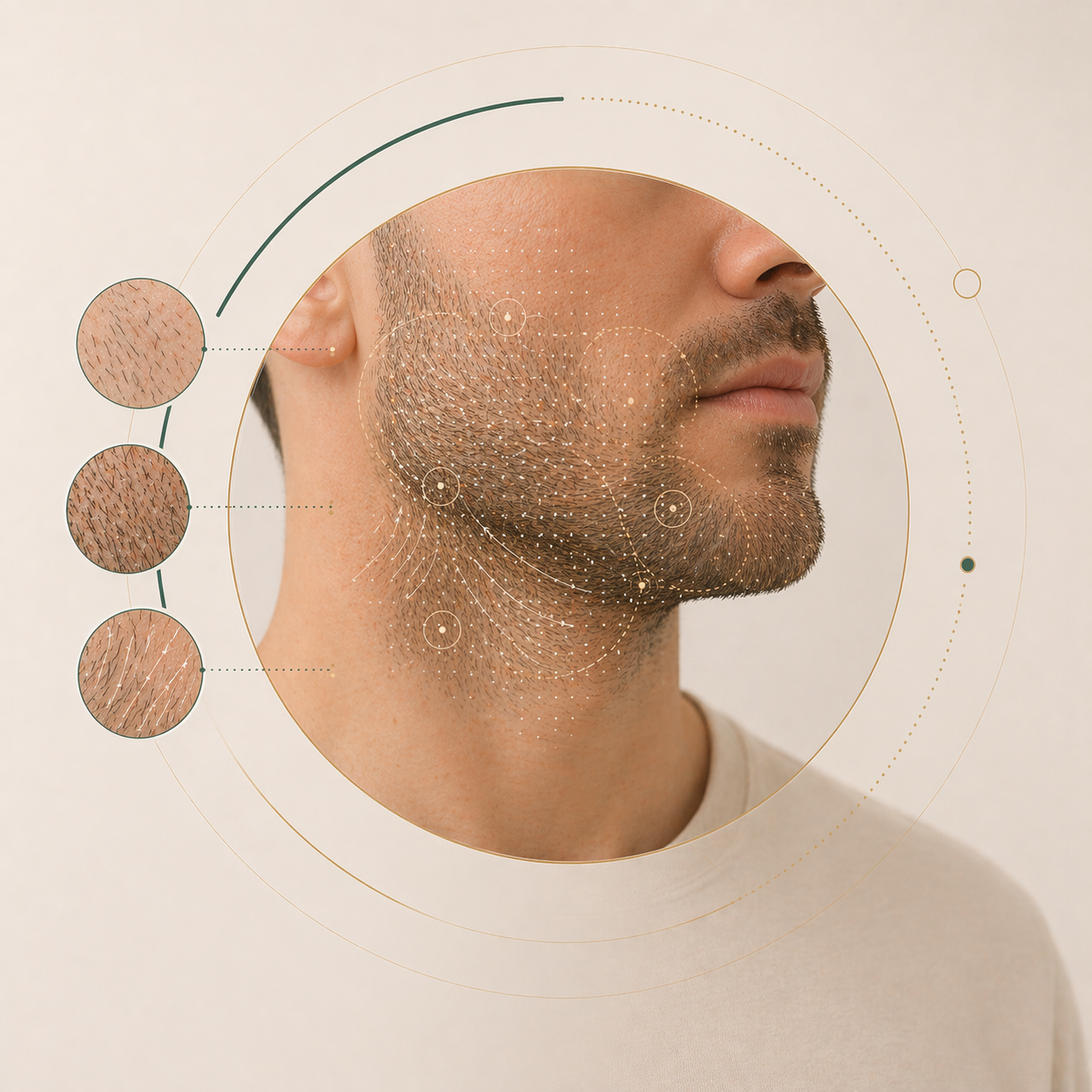
Suitability requires assessment.
Beard transplantation is not suitable for everyone. Factors including donor hair quality, skin conditions, medical history, and the cause of beard absence all affect whether treatment is appropriate. A medical consultation is required before any treatment plan can be developed.
Donor hair
Adequate donor hair density in the scalp or body is required. This is assessed during consultation.
Medical history
Certain medical conditions or medications may affect suitability. Full medical history review is required.
Cause of beard absence
Alopecia, scarring, or other underlying conditions may require specific evaluation. Not all causes are surgically treatable.
Age and expectations
Age-related factors and realistic expectations are discussed during consultation. No specific outcome can be guaranteed.
Beard transplant suitability can only be confirmed through direct medical consultation. This page does not provide a diagnosis, treatment recommendation, or specific outcome prediction. Results vary between patients. Treatment may not be appropriate for all cases.