
A Structured, Doctor-Led Method.
Every LP Clinic procedure follows a defined sequence — from initial donor assessment to post-treatment follow-up. No procedure is approved without the specialist's direct review.
LP Clinic does not follow a one-size-fits-all protocol. The number of grafts, the technique parameters, and the hairline design are determined individually — based on each patient's donor area, degree of hair loss, and personal goals. Standardised packages are not offered.
How a hair transplant procedure is structured.
A hair transplant at LP Clinic involves four structured phases — each with a distinct clinical purpose.
Donor Area Assessment
Before any procedure is planned, the specialist evaluates the donor area — the back and sides of the scalp from which follicles will be harvested. The density, calibre, and quality of donor hair determines the scope of what is clinically feasible.
A minimum viable donor density is required. Patients with insufficient donor supply are advised accordingly — LP Clinic does not proceed when outcomes are unlikely to meet clinical standards.
Hairline Design & Treatment Planning
The hairline is designed in consultation with the patient, based on facial proportions, natural hairline patterns, and long-term considerations around future hair loss progression. The design is not purely aesthetic — it must also be clinically sustainable.
The treatment plan specifies the number of grafts, the zones to be covered, and the session structure. This plan is presented and discussed before the patient commits to the procedure.
FUE Extraction & Implantation
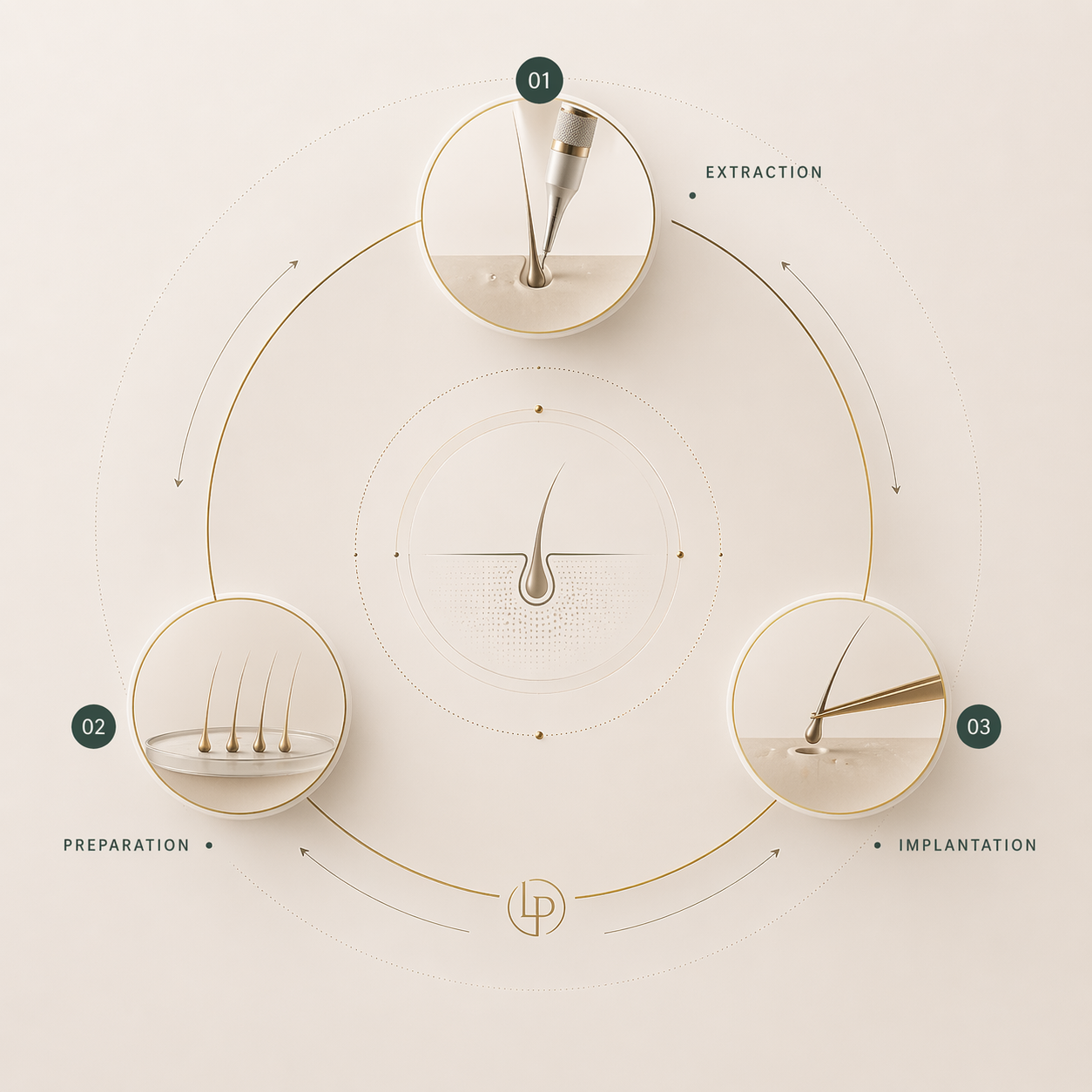
Follicular Unit Extraction (FUE) involves harvesting individual follicular units from the donor area using a micro-punch tool, then implanting them into the recipient sites. The procedure avoids a linear scar and allows for more natural-looking distribution.
The procedure is performed under local anaesthesia. The duration depends on the number of grafts planned. The specialist oversees all clinical stages of the procedure directly.
Post-Treatment Protocol
Recovery guidance is provided at the point of discharge. Patients receive instructions on washing, activity restrictions, and what to expect during the healing period. Remote follow-up via WhatsApp is available throughout the recovery process.
Initial shedding of transplanted hairs in the first weeks is normal and expected. New growth typically begins to be visible within several months, with full results developing over the following year. Individual timelines vary.
About FUE hair transplantation.
FUE (Follicular Unit Extraction) is the current standard technique for hair transplantation. Understanding the technique helps patients set realistic expectations.
What LP Clinic does not promise.
-
No specific hair density outcome is guaranteed.
-
No guarantee of identical results to any photograph or case study.
-
Recovery timelines are estimates — individual results vary.
-
Suitability for a procedure is confirmed in person — not remotely.
-
No guarantee that hair loss will not continue in untreated areas after the procedure.