
Hair restoration into scar tissue.
FUE+ID transplantation over surgical, burn, and trauma scars — planned around the scar's vascular state and follicle survival.
Not every scar is transplantable — each case needs assessment.
Scar tissue has reduced blood supply and a different structure than healthy scalp. The survival rate of transplanted follicles depends on the scar's age, thickness, vascularity, and the underlying cause. Only a direct medical assessment can determine whether a scar is suitable for transplantation — and in what density.
-
Surgical and trauma scars
Scars from previous hair transplants, face-lifts, injuries, or accidents may be considered for restoration. Each case depends on scar maturity (usually at least 12 months old), thickness, and surrounding skin quality.
-
Burn scars
Burn scars require specific evaluation. Scar depth, elasticity, and vascular state strongly affect graft survival. Treatment may need to be staged across multiple sessions, or may not be suitable at all.
-
Planned density
Density into scar tissue is typically planned lower than in healthy scalp to match realistic follicle survival rates. The doctor discusses expected outcome and limits before any plan is confirmed.
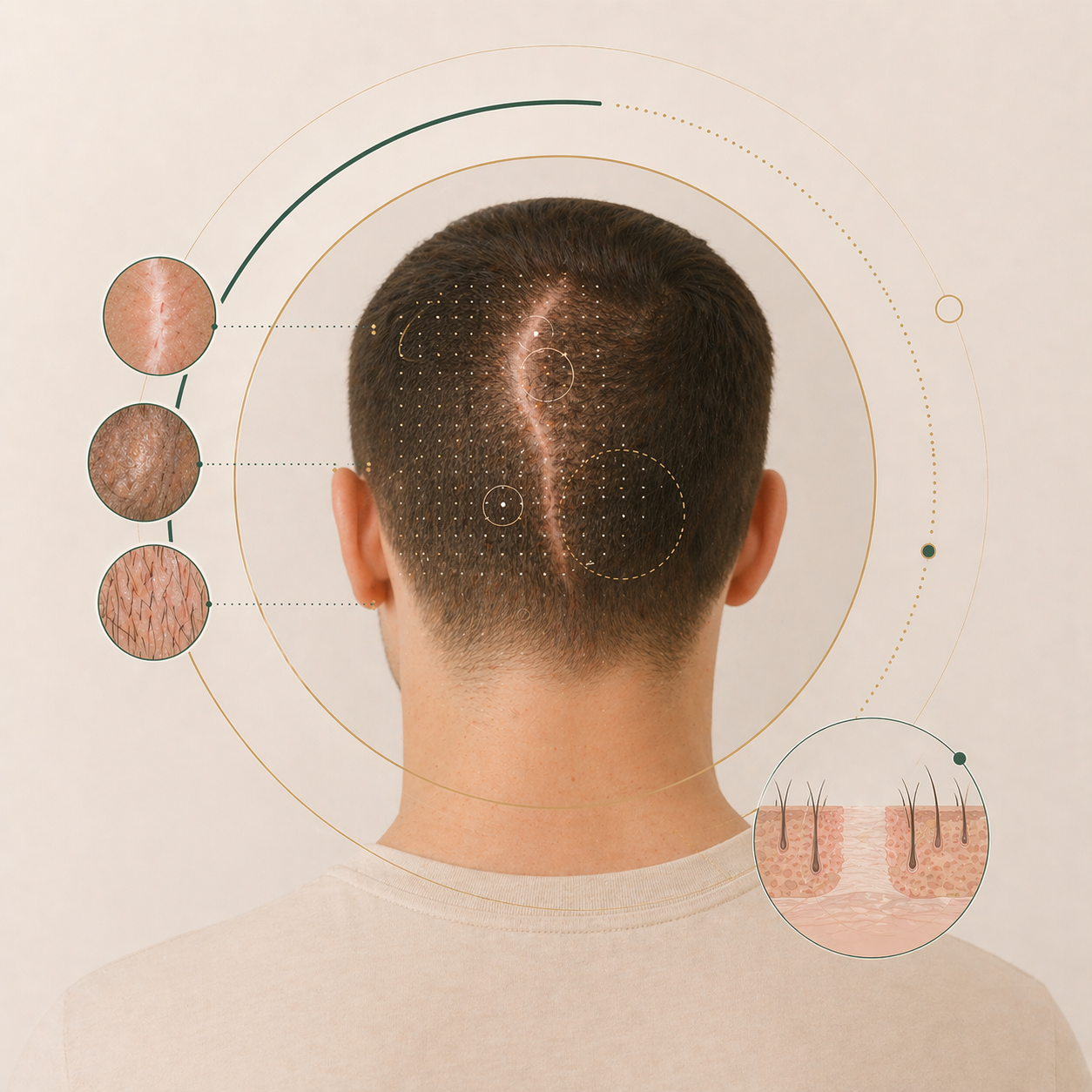
Scar transplantation requires individual assessment.
Not every scar can be transplanted. Age of the scar, cause, thickness, vascular supply, donor capacity, and medical history all affect whether treatment is appropriate — and what outcome is realistic. A medical consultation is required before any treatment plan is developed.
Scar maturity
Most scars require at least 12 months of healing before transplantation can be considered. Fresh scars are usually not treatable.
Vascular state
Adequate blood supply in the scar tissue is essential for follicle survival. Thin, atrophic, or heavily keloid scars may not be suitable.
Donor capacity
Sufficient donor hair is required — scar transplantation typically uses more follicles per cm² than the scar ultimately retains.
Realistic expectations
Density and coverage into scar tissue are typically lower than in healthy scalp. The doctor discusses what is achievable before a plan is confirmed.
Scar hair transplant suitability can only be confirmed through direct medical consultation. Follicle survival rates into scar tissue are typically lower than in healthy scalp and vary between patients. This page does not provide a diagnosis, treatment recommendation, or specific outcome prediction. Treatment may not be appropriate for all cases.